Showing posts with label Computer Science/Programming Language/JAVA. Show all posts

Sunday, May 13, 2012

Bluetooth For Java

Book Description

March 26, 2003 1590590783 978-1590590782 1
Bluetooth is a technology for wireless communication that functions in much the same way that home/office laptops connect to the Internet. It is typically used for short burst communications instead of a continuous connection. Because of this difference, Bluetooth is more typically found supported in wireless phones and personal devices.
Bluetooth for Java is not an overview of Bluetooth. In the book, Bruce Hopkins and Ranjith Antony describe how to develop wireless Java applications using Bluetooth for a variety of platforms. This includes an API overview of the Java library, development of Bluetooth-based services, highlights of security concerns, and walkthroughs for development with some of the different tools available. Programs will not be just J2ME (micro devices)-based, but will also be for J2SE (client/desktop).

About the Author

Ranjith Antony earned his bachelor's degree in computer engineering from the College of Engineering, Chengannur, Kerala, India, an institute affiliated with Cochin University of Science and Technology. He became a lecturer in the Department of Computer Engineering of the Government Model Engineering College. In June 1998, he joined Atinav as a software engineer. Presently, he is working as a senior technical manager and is managing the Bluetooth-related Java products from Atinav.

Bruce Hopkins is a 6-year Java veteran with experience in distributed computing and wireless networking. He has an electrical and computer engineering degree from Wayne State University in Detroit and has interest in robotics, microcomputing, and electronics. He has worked in Java since JDK 1.0a, and his research studies include distributed computing, clustering, encryption, and pervasive computing. He currently works as an independent consultant in the Detroit area. 

Product Details


The Art of Java

Book Description

July 31, 2003 0072229713 978-0072229714 1
There is something for every programmer in this book, which presents a number of practical, high-powered applications of Java. Included are pure code subsystems such as the expression parser, which readers will adapt for use in their own programs, financial calculations and statistics programs that feature ready-for-use applets/servlets, interpreter or the AI-based search engine, and much more.
 

About the Author

Herb Schildt (Mahomet, IL) is a leading authority on C and C++ and a best-selling author whose books have sold more than 2 million copies. His acclaimed C and C++ books include Teach Yourself C, C++ from the Ground Up, C++: The Complete Reference, Java Programmer's Reference, STL Programming from the Ground Up, Windows 98 Programming from the Ground Up, and co-author of C/C++ Annotated Archives.  

Product Details


Wireless Java: Developing with J2ME (2nd Edition)

Book Description

March 5, 2003 1590590775 978-1590590775 2nd
Although Java is incredibly popular, the standard edition of Java is way too big and bulky to build applications for wireless devices such as PDAs and phones. Thus, Sun has released Java 2 Platform, Micro Edition (J2ME). J2ME has the potential to be as revolutionary in the wireless space as Java has been in the server space.
Wireless Java: Developing with J2ME, Second Edition is updated to include coverage of the next version of programs for mobile Java devices. MIDP 2.0 contains many exciting new features, such as sound HTTPS support, lots of user interface API enhancements, a Game API, and much more. Also, author Jonathan Knudsen makes clear what material is new, so readers can still use the book for MIDP 1.0/CLDC 1.0.

About the Author

Jonathan Knudsen is a Java developer and noted author of several books, including Wireless Java: Developing with J2ME, Second Edition, Mobile Java, The Unofficial Guide to LEGO MINDSTORMS Robots, Learning Java, and Java 2D Graphics. Jonathan began his object-oriented programming career in Objective-C on the NeXT OS, soon thereafter suffering through a couple of purgatorial years in Microsoft's Visual C++, before graduating to Java in 1996. He has written extensively about Java and LEGO robots, including five books, a monthly online column called "Bite-Size Java," and articles for JavaWorld, EXE, NZZ Folio, and the O'Reilly Network. Jonathan holds a degree in mechanical engineering from Princeton University. You can find him at www.jonathanknudsen.com. 

Product Details


Friday, May 11, 2012

Applied Java Patterns

Book Description

January 5, 2002 0130935387 978-0130935380 1
Sun Microsystems experts Stelting and Maassen describe how design patterns can be applied effectively to the Java platform and present proven techniques for all types of patterns, from system architecture to single classes. Applied Java Patterns features a pattern catalog organized into four major categories - the creational, structural, behavioral, and system patterns. In addition, the authors identify patterns in the core Java APIs and present techniques for pattern use in distributed development.
 

About the Author

STEPHEN STELTING is an instructor for Sun Microsystems specializing in Java technology and object-oriented programming. For over a decade, he has worked in software development, consulting, and technical training. He currently develops new course content and teaches a wide variety of introductory and advanced courses.
OLAV MAASSEN is a courseware developer for Sun Educational Services and a Master Instructor for Sun Ed in the Netherlands. He is a certified Java Developer as well as an Enterprise Architect.

Product Details


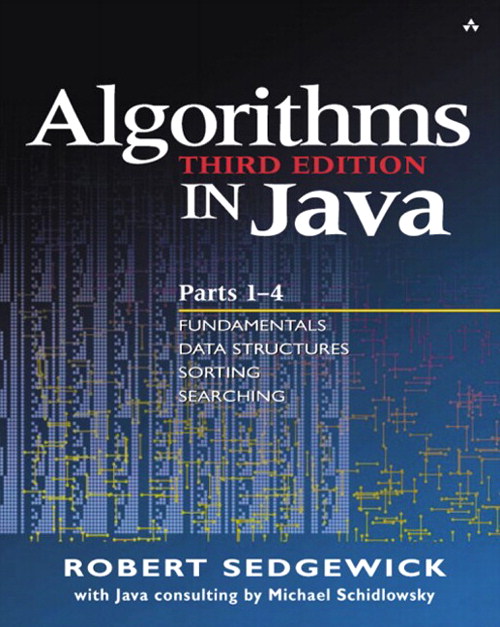
Algorithms in Java, Parts 1-4 (3rd Edition)

Book Description

August 2, 2002 0201361205 978-0201361209 3
For the first time, Sedgewick's seminal work on algorithms and data structures is available with implementations in Java. Michael Schidlowsky and Sedgewick have developed new Java code that both expresses the methods in a concise and direct manner, and also provides programmers with the practical means to test them on real applications. This particular book, Parts 1-4, represents the essential first half of Sedgewick's complete work. Its four parts are fundamentals, data structures, sorting, and searching. It has expanded coverage of arrays, linked lists, strings, trees, ADT's, and object-oriented programming.
 

About the Author

Robert Sedgewick is the William O. Baker Professor of Computer Science at Princeton University. He is a Director of Adobe Systems and has served on the research staffs at Xerox PARC, IDA, and INRIA. He earned his Ph.D from Stanford University under Donald E. Knuth.

Product Details

Monday, May 7, 2012

Advanced Java Networking (2nd Edition)

Book Description

April 14, 2000
Advanced Java Networking, Second Edition is a complete update to the #1 book on Java networking. The book is designed to help developers choose among Java's wide range of networking facilities -- and then implement networking as quickly and effectively as possible. This new edition includes complete coverage of new Java tools and APIs, including Jini, JMAPI, servlets, and JNDI; plus guidance for Web-enabling any application. Start with a practical review of TCP/IP and Sockets programming; next, master Java Database Connectivity (JDBC) and Remote Method Invocation (RMI). Use the Java IDL to build CORBA-compliant applications; master Java-based component models; and discover new ways to integrate Java with application servers. The book includes detailed chapters on Java security and architecting enterprise applications. The CD-ROM contains JDK2, the JNDI and Servlet APIs, and an evaluation copy of Inprise VisiBroker for Java.
 

Product Details


Sunday, May 6, 2012

Ajax on Java

Book Description

March 1, 2007 0596101872 978-0596101879 1
This practical guide shows you how to make your Java web applications more responsive and dynamic by incorporating new Ajaxian features, including suggestion lists, drag-and-drop, and more. Java developers can choose between many different ways of incorporating Ajax, from building JavaScript into your applications "by hand" to using the new Google Web Toolkit (GWT).
Ajax on Java starts with an introduction to Ajax, showing you how to write some basic applications that use client-side JavaScript to request information from a Java servlet and display it without doing a full page reload. It also presents several strategies for communicating between the client and the server, including sending raw data, and using XML or JSON (JavaScript Object Notation) for sending more complex collections of data.
The book then branches out into different approaches for incorporating Ajax, which include:
  • The Prototype and script.aculo.us Javascript libraries, the Dojo and Rico libraries, and DWR
  • Integrating Ajax into Java ServerPages (JSP) applications
  • Using Ajax with Struts
  • Integrating Ajax into Java ServerFaces (JSF) applications
  • Using Google's GWT, which offers a pure Java approach to developing web applications: your client-side components are written in Java, and compiled into HTML and JavaScript

About the Author

Steven Olson has been a software developer for 20 years, starting in 1984 with ForTran, Pascal, Basic, and, later, C at a company called Signetics. In 1991, he went to work for Novell, writing C. He began dabbling in Java, and in 1995 was one of the first to join the Java development group at Novell. Since then, he has consulted or worked directly for eight other companies writing primarily in Java. Currently, he works for logoworks.com, where his programming adventures continue.

Ajax gives web developers the ability to build applications that are more interactive, more dynamic, more exciting and enjoyable for your users. If you're a Java developer and haven't tried Ajax, but would like to get started, this book is essential. Your users will be grateful.


Product Details


Saturday, April 21, 2012

Programming Wireless Devices with the Java™2 Platform, Micro Edition (2nd Edition)

Book Description

June 20, 2003 0321197984 978-0321197986 2
This book presents the JavaaA A 2 Platform, Micro Edition (J2MEaA A ) standards that support the development of applications for consumer devices such as mobile phones, two-way pagers, and wireless personal organizers. To create these standards, Sun collaborated with such consumer device companies as Motorola, Nokia, NTT DoCoMo, Research In Motion, Samsung, Siemens, Sony Ericsson, and many others. The result is a highly portable, small-footprint application development environment that brings the unique capabilities of Java technology, including platform independence and enhanced security, to the rapidly growing wireless market. This definitive JavaaA A Series guide provides a programmer's introduction to the Java 2 Platform, Micro Edition. It presents a general description of wireless technology and an overview of the J2ME platform. In addition, the book details the Connected Limited Device Configuration (CLDC) version 1.1 and the Mobile Information Device Profile (MIDP) version 2.0, the standards that define the Java platform features and libraries for wireless, resource-constrained devices.Written by a team of authors that includes the original J2ME technology experts from Sun, Motorola, and Nokia, this book provides a description of the Java 2 Platform, Micro Edition, as well as practical implementation advice. The JavaaA A Series is supported, endorsed, and authored by the creators of the Java technology at Sun Microsystems, Inc. It is the official place to go for complete, expert, and definitive information on Java technology. The books in this Series provide the inside information you need to build effective, robust, and portable applications and applets. The Series is an indispensable resource for anyone targeting the JavaaA A 2 platform.

Product Details


XML and Java™: Developing Web Applications

Book Description

May 23, 2002 0201770040 978-0201770049 2
XML and Java(tm): Developing Web Applications is a tutorial that will teach Web developers, programmers, and system engineers how to create robust XML business applications for the Internet using the Java technology. The authors, a team of IBM XML experts, introduce the essentials of XML and Java development, from a review of basic concepts to thorough coverage of advanced techniques. Using a step-by-step approach, this book illustrates real-world implications of XML and Java technologies as they apply to Web applications. Readers should have a basic understanding of XML as well as experience in writing simple Java programs. XML and Java enables you to:
* Develop Web business applications using XML and Java through real-world examples and code * Quickly obtain XML programming skills * Become familiar with Document Object Models (DOM) and the Simple API for XML (SAX) * Understand the Electronic Document Interchange (EDI) system design using XML and Document Type Definition (DTD), including * coverage on automating business-to-business message exchange * Leverage JavaBean components * Learn a hands-on, practical orientation to XML and Java
XML has strong support from industry giants such as IBM, Sun, Microsoft, and Netscape. Java, with its "write once, run anywhere" capabilities, is a natural companion to XML for building the revolutionary Internet applications described in this book. XML and Java demonstrates how developers can harness the power of these technologies to develop effective Web applications. If you want to learn Java-based solutions for implementing key XML features--including parsing, document generation, object tree manipulation, and document processing--there is no better resource than this book.

Product Details


The Essence of Object-Oriented Programming with Java™ and UML

Book Description

January 5, 2002 0201734109 978-0201734102
This book can give any Java developer -- regardless of experience -- the firm foundation they need to achieve the full benefits of object-oriented programming. The book combines practical introductions to UML, object-oriented methodologies, design patterns, libraries, and frameworks -- giving developers all the skills they need to begin writing robust object-oriented programs -- and to tackle the entire field of object-oriented development. Leading developer Bruce Wampler begins with a brief introduction to objects and their benefits; then introduces the fundamental concepts of object orientation and shows how they can be implemented in Java -- starting with the basics, and moving on to advanced topics such as object lifetime and copies of objects. He moves on to Object-Oriented Analysis and Design, introducing the essential concepts at the heart of every methodology. Next, he presents the essence of today's leading techniques for building effective object-oriented Java systems -- including design patterns, refactoring, and more. Wampler concludes by drawing on his decades of development experience to share powerful personal guidelines for creating more effective software. For all application developers who know at least the basics of Java, and are seeking to strengthen their object-oriented programming skills.
 

About the Author

Bruce E. Wampler, founder and CEO of Object Central, was a pioneer in developing spelling and grammar checking software for personal computers, and the co-founder of Reference Software International, which was later acquired by WordPerfect. During his extensive career, he has worked at Sandia National Laboratory and taught at the University of New Mexico. He has also developed and delivered many successful, real-world applications, and several widely used open source object-oriented programming tools.

Product Details


The Design Patterns Java Companion


Micro Java™ Game Development

Book Description

April 28, 2002 0672323427 978-0672323423 1
Micro Java Games Development explains game development for devices that support J2ME MIDP. The six parts cover a full range of topics, from a tour of all available micro-devices (Palms, cell phones and pagers), a discussion of software standards apart from J2ME (cell phones, messaging, I-mode and wireless enhancements such as Bluetooth), and available J2ME extensions (Siemans, Ericcson, Nokia), development tools and restrictions, to the creation of a meaty J2ME game!
 

About the Author

David Fox works for Next Game, Inc., creating Web and wirelessmultiplayer games. Prior to that, his design and development credits includeMichael Crichton's "Westworld 2000," Fox Interactive's"X-Files: Unauthorized Access," and PlayLink's real-time strategy"Citizen 01." He is the author of several best-selling books aboutInternet technologies, and his writing frequently appears in publications suchas Salon.com, Gamasutra, and Developer.com. David has presented topics in Javagaming at Sun Microsytem's JavaOne conference for the past three years, andhas been the winner of the Motorola-Nextel Developer Challenge for the past twoyears.
Roman Verhovsek is CEO and co-founder of Cocoasoft Ltd., where he isleading a team of J2ME developers. He holds a bachelor's degree inelectrical engineering from the University of Ljubljana, and is working on hismaster's degree of computer science. Since early 1996, he has focusedprimarily on Java technologies, and for last two years in particular onJava-enabled small devices. In 2001 he held a lecture on J2ME game developmentat the JavaOne conference. In his other life, Roman enjoys cooking,mountaineering, jogging, and traveling with his girlfriend, Lina.
 

Product Details


The Java™ Tutorial: A Short Course on the Basics

Book Description

January 7, 2001 0201703939 978-0201703931 3
(Pearson Education) A hands-on guide to proficiency with Java, with clear explanations of fundamentals such as objects, classes and data structures. The CD-ROM contains 3 Java tutorial books in HTML, all major versions of the Java platform, and more. Softcover. DLC: Java (Computer program language). 
 

Product Details


Java 2 Platform, Enterprise Edition: Platform and Component Specifications

Book Description

May 30, 2000 0201704560 978-0201704563 1st
The newly-released Java TM 2 Platform Enterprise Edition (J2EE) is rapidly becoming the hottest technology for enterprise development. This complete, authoritative J2EE specification, direct from Sun Microsystems, is all developers need to know to deploy J2EE. Java 2 Enterprise Edition Specifications contains detailed coverage of the J2EE standard platform for application hosting; the new J2EE compatibility test suite; Sun's J2EE Reference Implementation; and the J2EE application model for developing multi-tier thin-client services. Every key element of J2EE is presented, including new technologies generating serious excitement amongst enterprise developers: servlets, JavaServer Pages, JNDI, and Enterprise JavaBeans. Coverage also includes security, JDBC, RMI-IIOP support, the Java Transaction API, interoperability issues, XML support, and more -- including a full chapter on the future of Java 2 Enterprise Edition.

Product Details


Java(TM) Performance and Scalability (Volume 1) : Server-Side Programming Techniques

Book Description

June 2, 2000 Java Performance and Scalability (Book 1)
Performance is now the area where Java is being put to the test, offering ever greater competitive advantage for those who master it. In this book, one of the world's leading software optimization experts presents 48 lessons that address virtually every aspect of Java server-side performance, Java Performance and Scalability, Volume I proves that, through careful attention to underlying source code and program design, the Java programming language can meet and exceed developers' greatest expectations. Dov Bulka targets the most common and critical Java performance pitfalls, offering dozens of practical tips and solutions covering each performance-critical area. Bulka has done the hard work of digging deep into the JDK to understand Java performance in unprecedented depth. This book includes not only code examples, but actual measurements quantifying the improvements they deliver. Coverage includes strings, containers, numerics, I/O, RMI, JDBC, servlets, JSP, and much more -- including a complete case study that walks through improving the performance of a Web server by a full order of magnitude.
 

Product Details


Inside Java™ 2 Platform Security: Architecture, API Design, and Implementation (2nd Edition)

Book Description

June 6, 2003 0201787911 978-0201787917 2
Series: The Java Series Security is an integral part of the Java platform; all Java APIs are built on a solid security model. That model has always been stronger than the security of other platforms, never allowing for the proliferation of a large virus such as "Melissa" or "I Love You." Now improved security and robust performance peacefully coexist. This book provides a detailed look into the central workings of the Java security architecture, including coverage of the many v1.4 enhancements. This book reviews multiple security threats, such as Trojan horses and denial of service attacks, and the strategies used to combat them. Students will find a practical guide to the deployment of Java security, as well as tips on how to customize, extend, and refine the core security architecture. In addition, it touches on the evolution of Java security, from the restrictive days of the JDK 1.0 sandbox to the sophisticated security features available in Java 2. The book even includes a list of 11 security bugs found in early versions of Java.
 

Product Details


Java Development on PDA's

Publisher: Addison Wesley
Pub Date: June 05, 2003
ISBN: 0-201-71954-1
Pages: 256


With the release of Java 2 Micro Edition (J2ME), Sun Microsystems opened Java to the rapidly expanding Personal Digital Assistant (PDA) market.
This comprehensive tutorial and reference provides an in-depth look at developing PDA software with J2ME and PersonalJava, covering both Palm and PocketPC devices. Succinct and practical, Java(TM) Development on PDAs focuses on real-world programming tasks with extensive code examples and an end-to-end PDA application demonstrating techniques for integrating devices with the enterprise via Web services.
This book describes the J2ME platform and PersonalJava and discusses design issues specific to resource-constrained devices. It also provides in-depth coverage of networking and Internet access, the user interface, data storage, and integrating PDAs into the corporation.
You will learn to develop Java applications for PocketPC and Palm devices through in-depth coverage of:
  • J2ME configurations
  • CLDC and CDC profiles
  • Selecting a PDA for development
  • PDA development tools
  • Designing for constrained computational capability
  • Designing for constrained screen and memory size
  • PDA user interfaces
  • Storing information on the devices
  • The Generic Connection Framework
  • Internet access from a Java PDA application via a GSM phone and Bluetooth
  • Accessing Web services from Palm and PocketPC devices
Java(TM) Development on PDAs concludes with a look into the future of PDA technology and the expanding role of these devices in the enterprise.

From Java to C#: A Developer's Guide

Book Description

January 17, 2003
The fastest way for Java developers to pick up C# and .Net - by leveraging on what they already know in Java to learn the new language. * Allows a Java developer to pick up C# as quickly as possible by highlighting the similarities and differences between the two languages. * Extensive detailed coverage of the new features in C# not found in Java. * A useful introduction to the .NET platform and how the new architecture works. It's important for a C# developer to know what happens behind the scenes.User Level: Intermediate. Audience: All intermediate Java developers. Technology: C# is a new programming language which is promoted by Microsoft as the successor to C++. C# together with Visual Basic .NET are the two most popular programming languages .NET developers use to write applications targeted at the .NET platform. Author Biography: Mok Heng Ngee is an experienced software developer and architect who has been involved in numerous large-scale software enterprise projects based on the Java 2 Platform, Enterprise Edition (J2EE). Mok has writes for Computer Times and has been invited to speak at the official launch of Visual Studio .NET in Singapore. He has been accorded MVP (Most Valuable Professional) status by Microsoft Asia.
 

About the Author

Heng Ngee Mok ("Mok") is an experienced software developer and architect who has been involved in numerous large-scale software enterprise projects based on the Java 2 Platform, Enterprise Edition (J2EE). Besides development work, Mok holds training classes for Java and J2EE technology. He lectures regularly at Nanyang Polytechnic's School of IT, a tertiary institution in Singapore. Mok writes frequently for Computer Times and has been invited to speak at Microsoft's Developer Festival and the official launch of Visual Studio .NET in Singapore. He has been accorded MVP (Most Valuable Professional) status by Microsoft Asia and is a Sun Certified Programmer for Java 2, a Sun Certified Web Component Developer for J2EE and a Microsoft Certified Systems engineer.

Product Details


Effective Java: Programming Language Guide

Book Description

June 15, 2001 0201310058
(Pearson Education) Working solutions to programming challenges faced by Java developers on a daily basis, revealing what to do to produce clear, robust and efficient code. Include rules in short essay form, and the author's 'war stories,' giving advice and insights into nuances of the language. Softcover. 
 

Product Details


Design Patterns Java™ Workbook

Book Description

April 4, 2002 0201743973 978-0201743975 1
This new workbook complements the classic Design Patterns, giving Java developers hands-on experience in transforming pattern concepts into working designs and code. Steven John Metsker presents nearly 90 practical pattern exercises, encompassing all 23 patterns first introduced in Design Patterns, and others that have since been identified. Metsker organizes Java design patterns by five categories of "intent": interfaces, responsibility, construction, operations, and extensions. Each section of the book focuses on one category, identifying the relevant challenges facing Java developers, and showing how specific patterns can be used to solve problems that recur in Java development and cannot easily be solved without their use. A Solutions chapter provides Metsker's detailed solutions to each problem, including -- where necessary -- UML diagrams. The accompanying CD-ROM contains all code from the book, plus additional bonus code not included in the book. For all Java developers who want to use patterns to improve their software.
 

Product Details